Books for understanding AI
Last week, I had the pleasure of presenting a keynote at the AI Consulting Conference 2026 in Munich, although I had to connect virtually from London due to other commitments. My key point is that AI is eating away at a lot of the magic powers that consultants used to wield, and that to stay relevant, you need to identify the gaps between what AI can do, and where experts are still needed. This is a moving target, and you need to understand something about how AI works to see where the gaps are.
Key slide here:
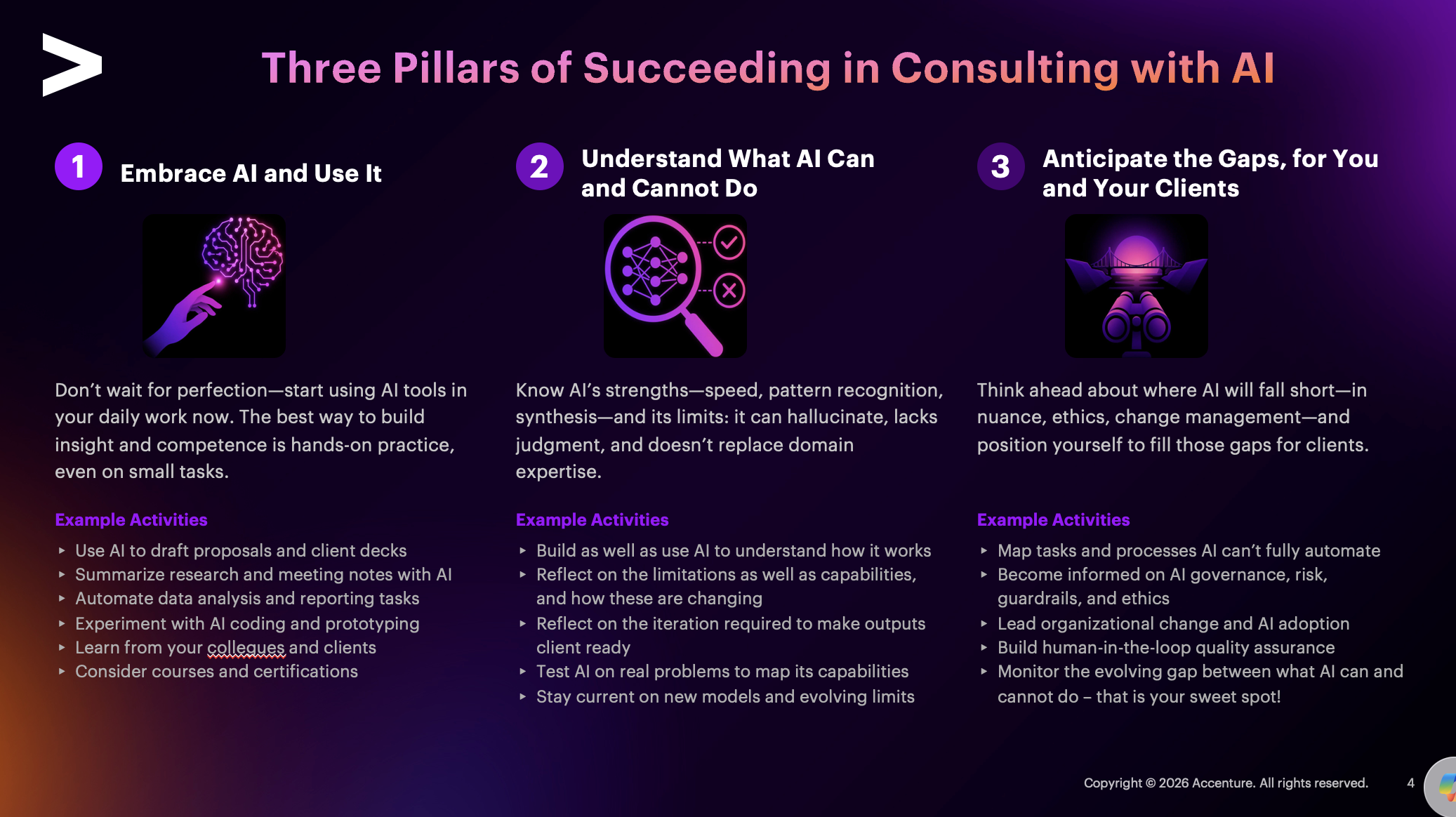
There are three requirements
- Use AI, so you can understand what it can and cannot do (and stay competitive)
- Deepen your understanding of how AI works, ideally at a technical level, so you can better understand its capabilities and limitations, new applications, and where it is going
- Look for the gaps between what AI can do and what people can do better, as this is your sweet spot for staying valuable and relevant
An important dimension here is to go beyond just LLMs. These are getting most of the attention (and funding) these days, but other types of AI are still highly relevant and useful, and will be the marks of well-rounded AI experts who can help solve really difficult problems. These techniques include optimization, logic programming, machine learning, causality, and deep reinforcement learning.
I mentioned that there are some good books, both technical and less technical, that I have found helpful to increase my understanding, so here are some titles.
Technical Books
Build a LLM from Scratch by Sebastian Raschka (Manning, 2026) takes you through the construction of an LLM based on GPT-2 using PyTorch, and teaches about tokenization, attention, transformers, training, and fine tuning along the way. I worked through this before starting my new role at Accenture, and found it very helpful for getting my head around how LLMs work.
Learn Generative AI with PyTorch by Mark Liu (Manning, 2026). Most people equate generative AI with LLMs, but this book takes a more holistic view, and takes you through exercises building generative adversarial networks and other neural-network based projects to generate text, images, and music. Also has an extensive section on LLMs and transformers.
Einstieg in Deep Reinforcement Learning (Hanser Verlag, 2020), German translation of Deep Reinforcement Learning in Action (Manning, 2020) by Alexander Zai and Brandon Brown. In either language, a really good exploration of deep reinforcement learning, and how it was able to learn to play games and perform more serious tasks. Gives an intuitive understanding of how deep learning allows a model to learn relevant features from data, such as rules and objects in images (such as walls or paddles in an Atari game). I hope this gets updated soon, but still found it very useful and helpful.
Less Technical Books
AI Snake Oil: What Artificial Intelligence Can Do, What It Can’t, and How to Tell the Difference is a smart critique of AI and LLMs in particular. Addresses how AI’s limitations are artifacts of the data and algorithms used to train models. A key point is that AI should be used with caution or not at all for predicting, but there are other good insights, underpinned by the authors’ technical experience.
How AI Thinks by Nigel Toon (Penguin, 2024) is a good, accessible overview of how AI works, and how it is different from human intelligence. Starts with a history of the technologies, and leads into a discussion of intelligence. Final section covers topics like applications, responsible AI, and future challenges.
The Atomic Human by Neil D. Lawrence (Penguin, 2025) is another good exploration of human vs. machine intelligence. A fundamental position of the book is that humans are “locked in” and limited by bandwidth in communicating with other humans, unlike machines that have near infinite bandwidth for sharing information between themselves. This is at once a limitation, but also a safety mechanism that protects human capability.